
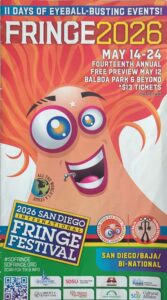
2026 SD Fringe Festival
By Paola Hornbuckle
The International Fringe Festival is a world-wide theatrical event with a multitude of locations in different cities and countries. It originated in Edinburgh, Scotland in 1947, when eight theatre companies showed up uninvited to a theatre festival without any space to perform. The rogue companies decided to perform on the “fringe”, or outer edges, of the main event.
The concept became a revolutionary event, that inspired the Annual International Fringe Festival, with open access to all artists regardless of professional status or curation, is uncensored, and other than a $7 dollar tag towards the Fringe Festival, all ticket revenue goes to artists. Applications to perform are on a first come, first serve basis.
The 2026 run of the San Diego International Fringe Festival was held May 12-24 and included 115 different acts and performance groups in over 20 venues, some south of the border. It included a variety of local, national, and international artists spanning theatre, dance, comedy and cabaret. I will be reviewing four shows I was lucky enough to see.
Alisha’s Light-Forever 57, written and performed by Alisha Richard (@alishar1976) at Golden Corpse Theatre, is about a woman’s struggle to accept her transgender identity, and the joy, relief, and wonder she feels to finally have the strength and courage to be herself. Alternating between poetic rhyme and dialogue in flashbacks, this one-woman show has an epic journey feel, with touching moments of vulnerability and acceptance. A psychological journey towards freedom reflected in Alisha’s steps into the world as her authentic self. Those steps included being honest with her family members, looking at herself admiringly wearing a dress in front of a hotel mirror, or expressing her frustrations about the controversial choice of which public restroom to use when she desperately needs to go, all wrapped in incurable optimism. It’s a feel-good show that helped me understand and put myself in the place of a transgender person.
Big Money, written by Lynnsey T. Pedre & Kent Brisby, presented by Asian Story Theater and performed at No Limits Theatre, tells the story of Yap, and island in Micronesia. The cast, consisting of four lovely dancers in traditional costume that played various roles, and three narrating characters, engaged the audience with originally choreographed dance sequences intermixed with truly interesting storytelling. The show focused on the arrival of Irish American David O’Keefe in the late 1800s on Yap and his relationship with the Yap people. I learned about the colonizing empires that took turns overseeing Yap and the huge stone donut shaped rocks that the Yap people used as money. Overall, a very informative and entertaining piece on a part of the world I knew very little about. (cast: Rio Dael, Angellyne DePerio, Kali Kamaria, Amy Pfleeger, Gigerlily Loive, Frankie Taitingfong, Kenty Brisby, Co-directed by Rhys Greene)
The Fairy Tale Monologues by Sarah Alida LeClair, presented by Riot Productions at SDSU Prebys Theatre, is a musical that takes on fairy tale archetypes and characters, portraying them as complex and unfulfilled, except for the witch. The witch, played by the playwright, Sarah Alida LeClair, is the only fully realized and content character. The other characters, the prince (Tim Benson), the princess (Delia Mejia), the baker’s wife (Josalyn Johnson), and the baker (BJ Johnson), seem to be missing something. They are unhappy and searching, and they all end up at the witch’s house asking for help, or showering blame. The musical leads one to think beyond the stereotypes in fairy tales and to question: why are the archetypes historically portrayed in this way? A child narrator (Sylvie Nechev) begins the play with the line, “Her mother was dead to begin with.” It feels like the foreshadowing of spiritually dead women with no agency, trapped in social roles/prisons, that can’t nourish a child. Perhaps the spiritually whole witch, the object of projections and desires, strengthened by her self-assurance and independence, can be the better mother. (Directed by Alicia Gonzalez and Julie Benitez)
Perra, Puta, Loca, Bruja, written and performed by Vanessa Codorniu, has the tagline: A Latina’s Reclamation Journey. A one-woman show filled with music, dancing, storytelling, and a dash of spiritual evocation, in which the author explores her female ancestors’ (two grandmothers and a mother) cultural legacy while analyzing the mental scars she inherited from them in the process. Scars the include the Argentinian colonialist and colorist mindset, as well as the harsh judgement of genderized social roles, a judgement often meted out by the women themselves. Women loving, but keeping their progeny down at times. The words: perra, puta, loca, bruja, are examined as they relate to the crushed dreams and obvious wounds of her ancestors. Derogatory terms often used against women in Latino culture, are flipped to denote power and freedom by Vanessa in her dynamic show.
No Comments